The Science of Workout Music: Why Tempo Matters More Than Genre
By Dr David Bell, Specialist Anaesthetist (Retired), Software Engineer, and Founder of Align AI Fitness, NSW, Australia
Most of us build workout playlists the same way: pick songs we like, crank the volume, and hope for the best. Rock fans load up AC/DC. Hip-hop listeners queue Kendrick. EDM devotees swear by 170 BPM hardstyle. But decades of exercise science research point to a surprising conclusion: the genre on your playlist matters far less than its tempo.
The Researcher Who Proved It
Professor Costas Karageorghis at Brunel University London has spent over 25 years studying music and exercise performance. His work, spanning hundreds of studies, has produced what is arguably the most robust evidence base in sport psychology. In a landmark 2012 review, Karageorghis and Priest identified four factors that determine how motivating a piece of music is during exercise, arranged in a hierarchy:
1. Rhythm response (tempo, beat strength)
2. Musicality (harmony, melody, pitch)
3. Cultural impact (familiarity, how well-known the song is)
4. Association (extra-musical connections, like a song from a film)
The critical finding is the ordering. Rhythm response sits at the top. A song's beat pattern and tempo drive its motivational effect more than its melody, its cultural familiarity, or any personal memories attached to it. This hierarchy has been validated through the Brunel Music Rating Inventory (BMRI), a psychometric tool now widely used in research to score the motivational quality of music for exercise.
What the Numbers Say
The effect sizes are not trivial. A 2020 meta-analysis by Terry, Karageorghis, and colleagues pooled data from 139 studies and 3,599 participants. Music improved affective valence (how good you feel) with a Hedges' g of 0.48, physical performance at 0.31, and perceived exertion at 0.22. To put that in practical terms: at low-to-moderate intensity, music reduces how hard exercise feels by roughly 10%. For motivational music played in sync with movement, treadmill endurance increased by approximately 15% compared to exercising in silence.
A more recent meta-analysis by He and colleagues (2025), covering 59 studies and 507 effect sizes, confirmed these findings and added an important nuance. Exercise intensity moderates the effect. Music works best at moderate intensities. Once you cross the anaerobic threshold (roughly 75% of VO2max), internal physiological cues, your breathing rate, the burn in your muscles, dominate your attention. Music does not stop helping entirely at high intensity, but its ability to reduce perceived exertion diminishes. What it can still do is shift your emotional response, making the same hard effort feel more tolerable.
The BPM Sweet Spot
If tempo is the primary driver, what tempo should you target? The research converges on a preferred range of 125 to 140 BPM for most exercise types. The good news is that this range covers a huge slice of popular music: most pop, hip-hop, EDM, and rock tracks sit between 120 and 135 BPM, so building a well-matched playlist is easier than you might expect.
Here is a rough guide based on the literature:
| Exercise Type | Optimal BPM Range |
|---|---|
| Walking | 115-120 |
| Jogging | 120-125 |
| Running (moderate) | 125-140 |
| Cycling (general) | 125-140 |
| Strength training | 120-140 |
For race-pace running, the picture shifts. Elite runners typically sustain a cadence of 170 to 180 steps per minute, and the research on synchronisation suggests matching music tempo to stride rate. That means tracks in the 160 to 180 BPM range (think drum and bass, or fast electronic music) become relevant, but only for runners who are actively syncing stride to beat at high cadence.
One counterintuitive finding: preferred tempo does not increase linearly with exercise intensity. There are step changes and plateaus, particularly around 130 to 140 BPM. A 2024 study by Jones and Karageorghis explored this using unfamiliar, non-lyrical music at four test tempos (90, 110, 130, and 150 BPM). Participants consistently preferred the fastest option available, regardless of exercise intensity. The takeaway is not that 150 BPM is a magic number, but that when you strip away lyrics and familiarity, people gravitate toward faster tempos. If you are using instrumental or unfamiliar tracks, aim about 10 BPM higher than you would with songs you know well.
Your Body Syncs to the Beat (Whether You Realise It or Not)
Perhaps the most fascinating mechanism is spontaneous entrainment: the tendency for your body to unconsciously synchronise movement to an external rhythm. Van Dyck and colleagues (2015) studied recreational runners and found a remarkably strong linear relationship (r-squared of 0.96) between music tempo changes and cadence adaptation. Runners adjusted their stride rate to match the beat without being told to do so.
The entrainment window is narrow but meaningful. It works best within plus or minus 1 to 2 percent of your natural cadence, and drops off sharply beyond 2.5 percent. Women in the study entrained significantly more than men (median entrainment of 60% versus 39%). From a clinical perspective, this has implications beyond performance. If music can subtly reshape running gait without conscious effort, it opens the door to using tempo as a tool for rehabilitation and injury prevention.
Five Mechanisms, One Playlist
Drawing on Karageorghis's framework and subsequent research, there are five primary mechanisms through which music enhances exercise:
1. Dissociation - Music competes for your attention, diverting focus away from fatigue signals. This is most effective at moderate intensities.
2. Arousal regulation - Fast music increases physiological arousal (heart rate, breathing rate), priming you for effort. Slow music does the opposite, which is useful for cooldowns.
3. Synchronisation - Moving in time with the beat improves metabolic efficiency. Synchronous music during cycling has been shown to reduce oxygen consumption for the same power output.
4. Motor skill acquisition - Rhythm provides a temporal scaffold for repetitive movements, improving coordination and pacing.
5. Flow state facilitation - The right music, at the right tempo, can help you enter a state of absorbed focus where effort feels effortless.
What This Means for Your Next Session
The practical application is straightforward. When you build a workout playlist, start with tempo, not genre. Match the BPM to your planned exercise intensity using the table above. Use the BMRI hierarchy as a guide: prioritise strong, clear beats over complex melodies. If you are using unfamiliar instrumental music (common in cycling and running apps), push the tempo 10 BPM higher than you would for your favourite songs.
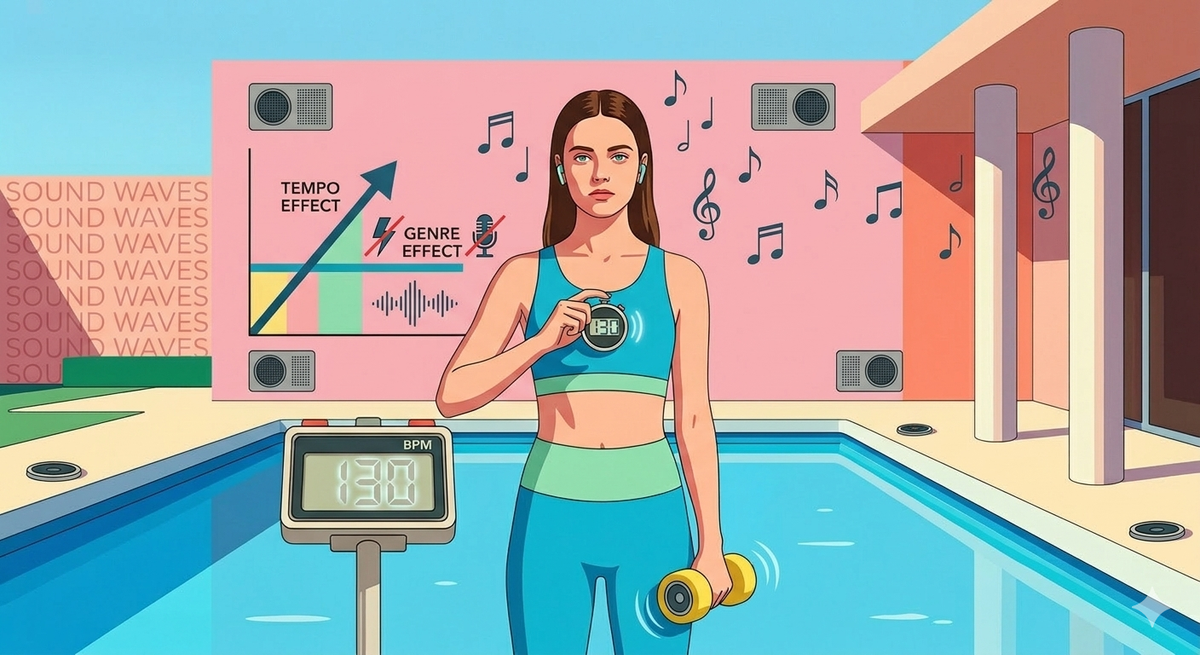
Personal preference still matters. The 2025 BMC meta-regression found that preferred music consistently outperforms non-preferred music on both psychological and physical measures. But here is the key insight: when researchers control for tempo and beat strength, genre differences largely disappear. A 130 BPM pop track and a 130 BPM metal track produce similar ergogenic effects, provided the beat is prominent and clear.
Your playlist does not need to be a genre statement. It needs to be a tempo prescription.
This is Part 1 of an 8-part series on music and exercise performance. Next: how platforms like Peloton and Apple Fitness+ engineer their playlists, and why most of them still get it wrong.
Dr David Bell is a specialist anaesthetist (retired), software engineer, and founder of Align AI Fitness, based in NSW, Australia.