
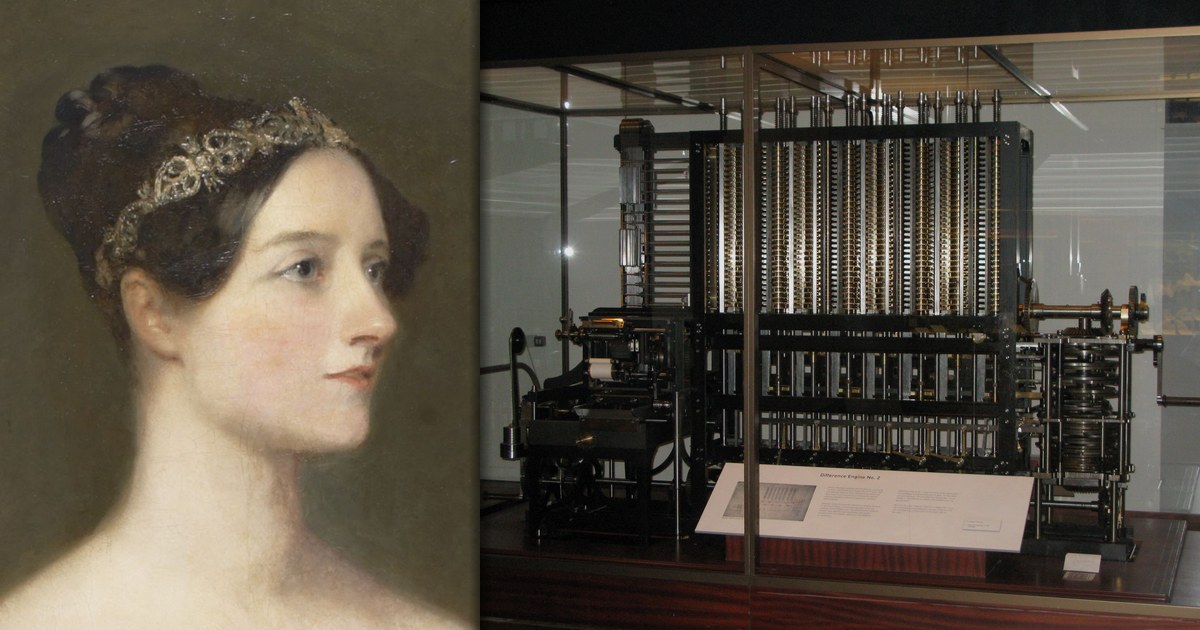
The book is called Lady Lovelace's Objection, after a sentence Ada Lovelace wrote in 1843 about Charles Babbage's still-unbuilt Analytical Engine. The Engine, she said, "has no pretensions whatever to originate any thing. It can do whatever we know how to order it to perform." Almost two centuries later, we are still arguing about whether she was right.
Chapter 1 is where that argument starts. Babbage and his impossible machine. Ada Byron, the daughter of a poet who had been trained in mathematics as an antidote to her father's temperament, walking into a drawing room and seeing what almost nobody else in the room could see.
This is the first chapter of Lady Lovelace's Objection, Dr David Bell's serialised history of computing, from Babbage and Lovelace through to today's large language models. New writing weekly.
In 1821, Charles Babbage and John Herschel were sitting together checking astronomical tables, long columns of figures computed by hand for the Royal Astronomical Society, when Babbage found yet another error. And then another. He had been finding errors in mathematical tables for years. Everyone who worked with them found errors. The tables were the computational infrastructure of the British Empire, and they were riddled with mistakes, and Babbage was the kind of person for whom this was not an acceptable state of affairs.
"I wish to God these calculations had been executed by steam," he said.
Herschel looked at him. "It is quite possible," he replied.
Most people would have let the moment pass. Babbage was not most people. He was the son of a wealthy London banker, a Cambridge-educated mathematician who had co-founded the Analytical Society as an undergraduate to reform British mathematics, and the holder of the Lucasian Professorship (Isaac Newton's chair) at which he would never deliver a single lecture. He was brilliant, sociable when it suited him, and incapable of encountering an imprecision and leaving it alone. He once wrote to Alfred Lord Tennyson to correct a couplet in "The Vision of Sin." The poem read: "Every minute dies a man / Every minute one is born." Babbage pointed out that if this were true, the population of the world would remain in a state of perpetual equipoise, and suggested Tennyson revise the line to: "Every minute dies a man / And one and a sixteenth is born." He conceded that the exact figure was 1.167, but something must, of course, be conceded to the laws of metre. Tennyson quietly changed "minute" to "moment" in subsequent editions, which was not what Babbage had asked for but was, perhaps, all that verse could bear.
This was the mind that looked at a table full of errors and saw a machine.
To understand why the errors mattered, you need to understand what the tables were and what they were for, because they were everything.
In the early nineteenth century, if you needed to multiply two large numbers, you did not multiply them. You looked up their logarithms in a table, added the logarithms together, and looked up the result in the table again to get the answer. If you were navigating a ship, you looked up the position of the moon and the stars in a table. If you were calculating an insurance premium, you looked up mortality rates in a table. If you were an engineer building a bridge, you looked up trigonometric values in a table. Every serious calculation in science, commerce, navigation, and the military ran through these books of pre-computed numbers. They were the search engines of their era, the layer between the question and the answer.
The most important was the Nautical Almanac, first published in 1767 and known as the Seaman's Bible. It tabulated lunar distances: the angular separation between the moon and specific stars at specific times, which allowed a navigator to determine longitude at sea. Get the longitude wrong and your ship was in the wrong place. Get it wrong enough and your ship was on the rocks. The Royal Navy depended on these tables absolutely, and the tables depended on human beings doing arithmetic by hand.
The process worked like this. A room of human calculators (the job title was literally "computer") would each perform a portion of the calculation, working with pen and paper, following prescribed steps. Their results were passed to a checker. The checked results were passed to a copyist, who produced a fair copy for the printer. The printer set the type by hand, one digit at a time. At every stage, errors crept in. Computation, checking, copying, typesetting. A digit transposed. A carry forgotten. A six misread as a zero. The errors were small and they were relentless, and they propagated through every copy of every table that was printed and distributed to every ship and every counting house in the empire.
This is an excerpt from Chapter 1 of Lady Lovelace's Objection, Dr David Bell's serialised history of computing.