
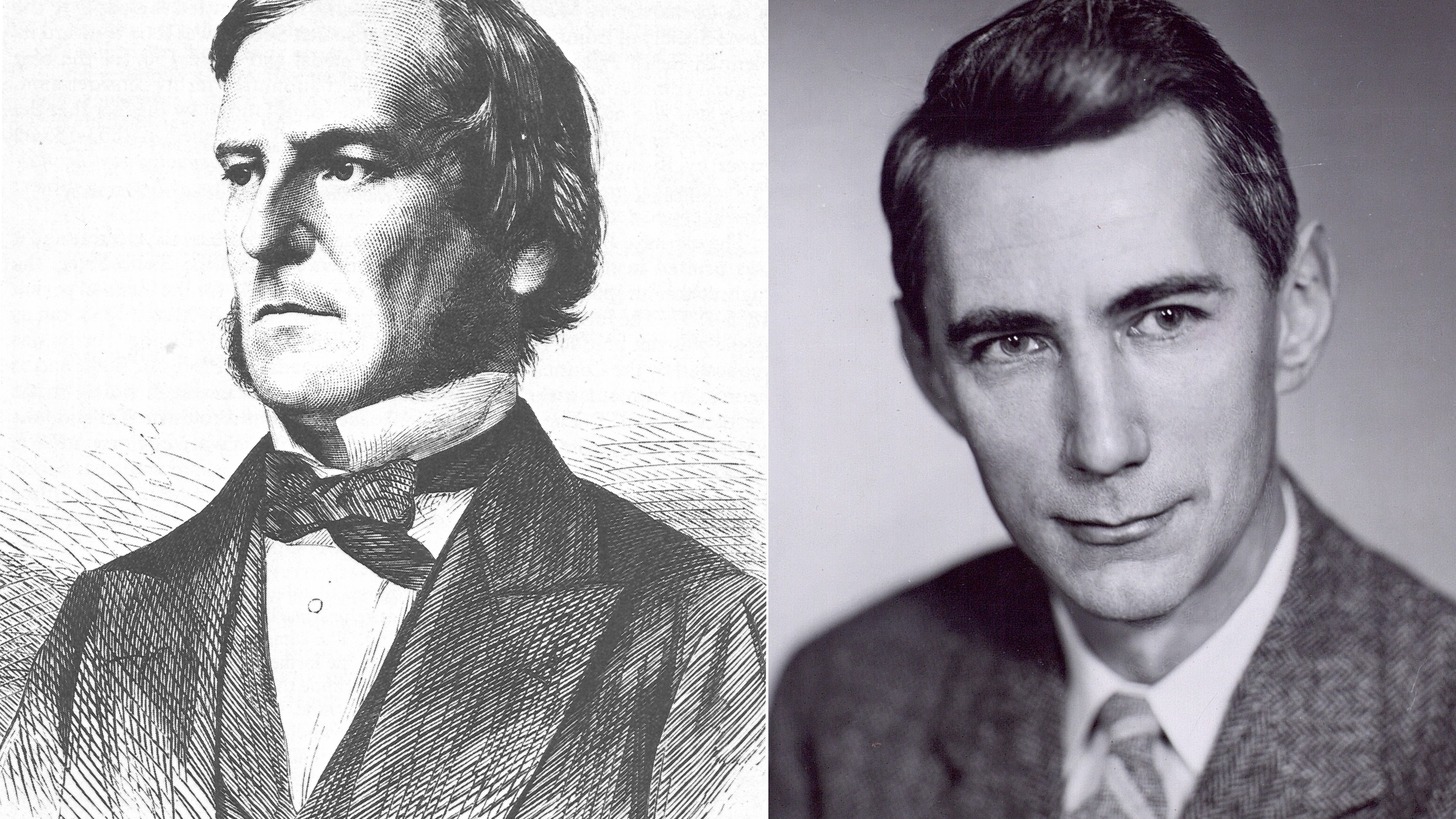
Chapter 2 of Lady Lovelace’s Objection goes up on Substack today. It is the Boole and Shannon chapter, the one I knew I had to write before I had written a word of the rest of the book, because every other chapter in the first half of the book leans on it. The story of how 0 and 1 became the substrate of modern computing starts with these two men, separated by eighty years and a body of water, and not connected by anything except the fact that the second one read the first.
Three things surprised me while I was writing it. I am putting them here because they did not all fit cleanly into the chapter, and because the chapter is on Substack already and I would rather use this space for the offcuts.
1. Boole really did teach himself everything
I went in expecting the usual autodidact narrative. A clever boy gets a few breaks and self-studies his way up. That is not quite what happened. George Boole, son of a Lincoln cobbler, taught himself Greek, Latin, French, German, and Italian before he was twenty, ran his own school by nineteen, supported his parents and three younger siblings from sixteen, and worked through Lacroix’s Differential and Integral Calculus at night, alone, without a tutor, without a study group, without a single university lecture to lean on. He won the Royal Society’s Royal Medal at twenty-eight. It was the first time the gold prize had ever been awarded for mathematics. He still did not have a degree.
The thing that struck me, writing this, is how recent this is. Boole was born in 1815. He died in 1864. He is closer to us in time than to the Enlightenment, and he was still doing the work in candlelight, in a regional English town, with no peers, no email, no library worthy of the name. The bandwidth available to a mind in 1840 was almost nothing, and he built a system that would outlast every other intellectual achievement of his century.
2. The death scene is worse than I remembered
Boole walked three miles to a lecture in pouring rain. He delivered it soaked. He came home with pneumonia. His wife Mary was a homeopath who believed in the principle of like cures like. Their daughter Lucy later wrote that Mary treated him by pouring cold water over his bedsheets, on the theory that the cause of an illness was also its cure.
Mary’s role in his death is contested. I tried to honour that in the chapter without softening the irony, which is that the man who reduced reasoning to a calculus of true or false was killed by a proposition his own algebra could have falsified. Whether the cold water hastened his end or simply failed to prevent it, the framing writes itself.
It is also a reminder, for anyone medically trained, of how recently we were doing this to each other. He died in 1864. Lister had not yet published on antisepsis. The germ theory of disease was a fringe European hypothesis. The treatments available to a forty-nine-year-old man with pneumonia and a homeopathic spouse were not good, and the alternative treatments available to a forty-nine-year-old man with pneumonia and an allopathic spouse were probably not much better.
3. Shannon’s master’s thesis is the most consequential graduate paper ever written
This one I have not been able to get out of my head. Claude Shannon was twenty-one. He had two undergraduate degrees from Michigan, one in electrical engineering, one in mathematics. He landed at MIT on a work-study arrangement and was put to work maintaining Vannevar Bush’s differential analyser, an analogue computer the size of a room. He looked at its control relays and saw, in those switches, the algebra of George Boole.
His thesis, written in 1937, married the two. It is the founding document of digital electronics, and it is barely seventy pages long.
In the chapter I argue that this is the moment when the modern world starts. Not when the first computer is built, not when ARPANET is wired up, not when the iPhone ships. 1937. A graduate student in Cambridge, Massachusetts, recognising an English logician’s hundred-year-old algebra in the click of an electromechanical switch.
Read Chapter 2 in full on Substack: Boolean Dreams.
The book serialises every other Tuesday. The next chapter, The Imaginary Machine, is on Alan Turing.